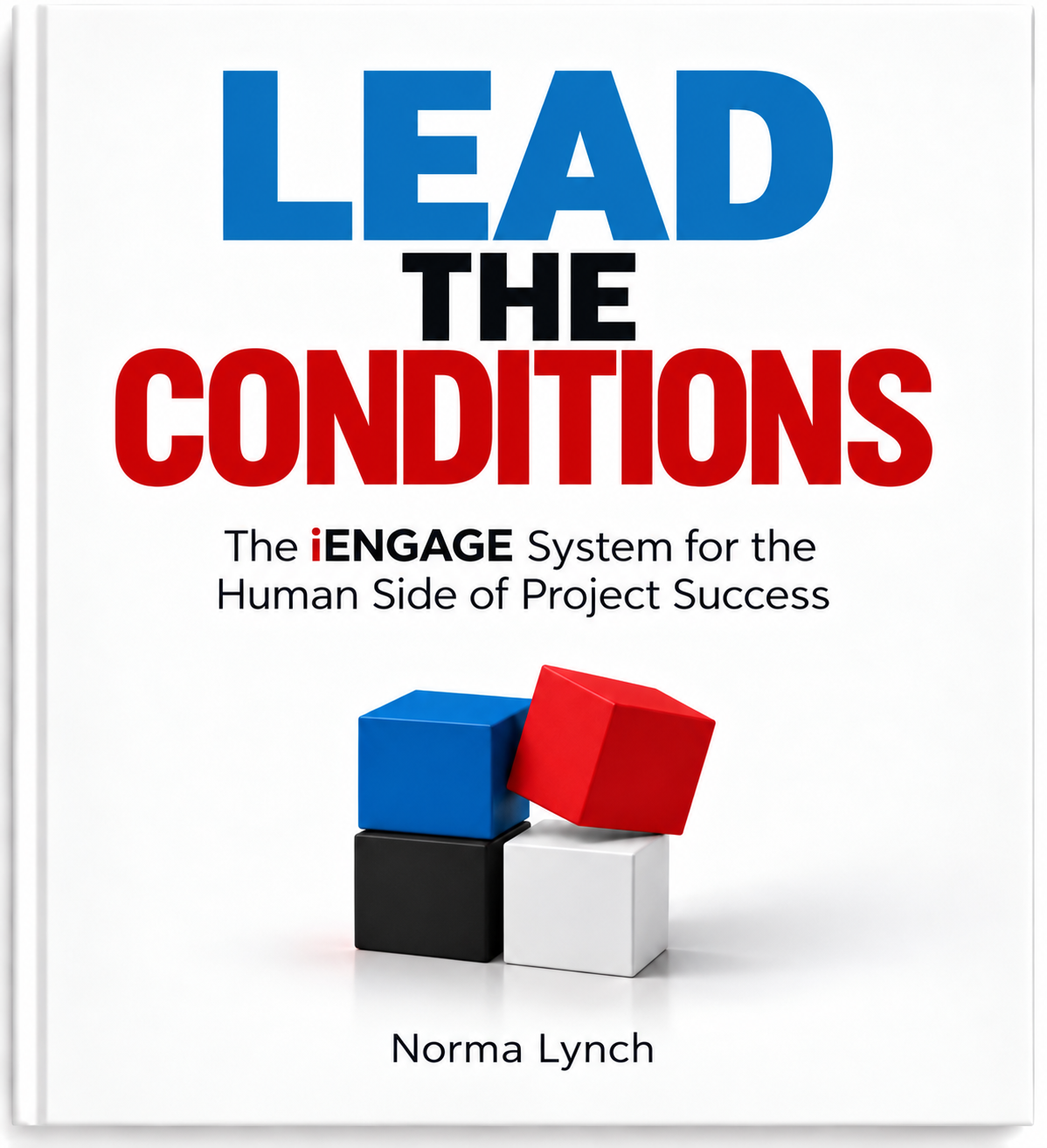
Lead the Conditions
The iENGAGE System for the Human Side of Project Success
Every project has a plan. Every project also has a human system. Only one of them is usually being led.
Project managers are given excellent tools for scope, schedule, cost, risk and quality. For the other half of the job — the half that actually determines whether the plan gets delivered — most have almost nothing. No structure. No common language. No diagnostic. Just instinct, and the hope that they will notice the human signals in time.
That gap used to be survivable. It isn't any more.
The profession now asks project professionals to own project success — not simply to deliver the outputs they were given, but to be accountable for whether the work creates value, and for how that value is experienced by the people it affects. It is a fair expectation. But it moves the ground under the role. You cannot own project success while leading only the technical half of it.
You cannot control people. You can lead the conditions in which they succeed.
Lead the Conditions is a practical system for doing exactly that.
What's inside
At the centre of the book is the iENGAGE cube — a physical object you keep on your desk, with a face for each of the five leadership conditions that projects run on:
- Empathize — understanding
- Nurture — energy
- Grow — adaptability
- Align — shared direction
- Guard — safety
A sixth face, Evaluate, is the sensing system that tells you whether the other five are actually being experienced — not whether you intended them.
The book gives you three things you can use immediately:
- The daily and weekly turn. How to read a human signal and act on it in the work you are already doing — in a stand-up, a status update, a corridor conversation — without adding meetings.
- The iENGAGE Diagnostic. A structured way to compare the conditions you believe you are creating with the conditions your team is actually experiencing. Leaders experience their intentions. Teams experience their behaviour. The diagnostic measures the space between the two.
- The 90-Day Reset. A phased plan for turning what you have read into habits that hold under pressure — not transformation, traction.
Who it's for
- Project, programme and portfolio managers who are being asked to own outcomes, not just deliverables
- Sponsors and senior leaders who shape the conditions around delivery, often without realising it
- PMO leads building capability rather than compliance
- Anyone who has watched a project go green all the way down and known it wasn't true
NLC Project Power | Midleton, Cork, Ireland | norma@nl-c.ie | 0879973336 | www.nl-c.ie